One-Stop Fragrance Development: Five Shifts Buyers Should Notice
One-stop fragrance development used to mean that a single supplier could compound and fill. Today the phrase covers a much longer chain, and an established beauty brand that still reads it the old way will buy too little. Five shifts explain most of the difference: scope has moved upstream into brief interpretation, packaging has moved into the same conversation as the formula, documentation has become part of the deliverable rather than a favour, regulatory reasoning has become a service, and the timeline has become something suppliers are asked to defend rather than announce. None of these changes is universal, and that is precisely why they matter. Two suppliers offering nominally the same service can be operating on two different versions of it.
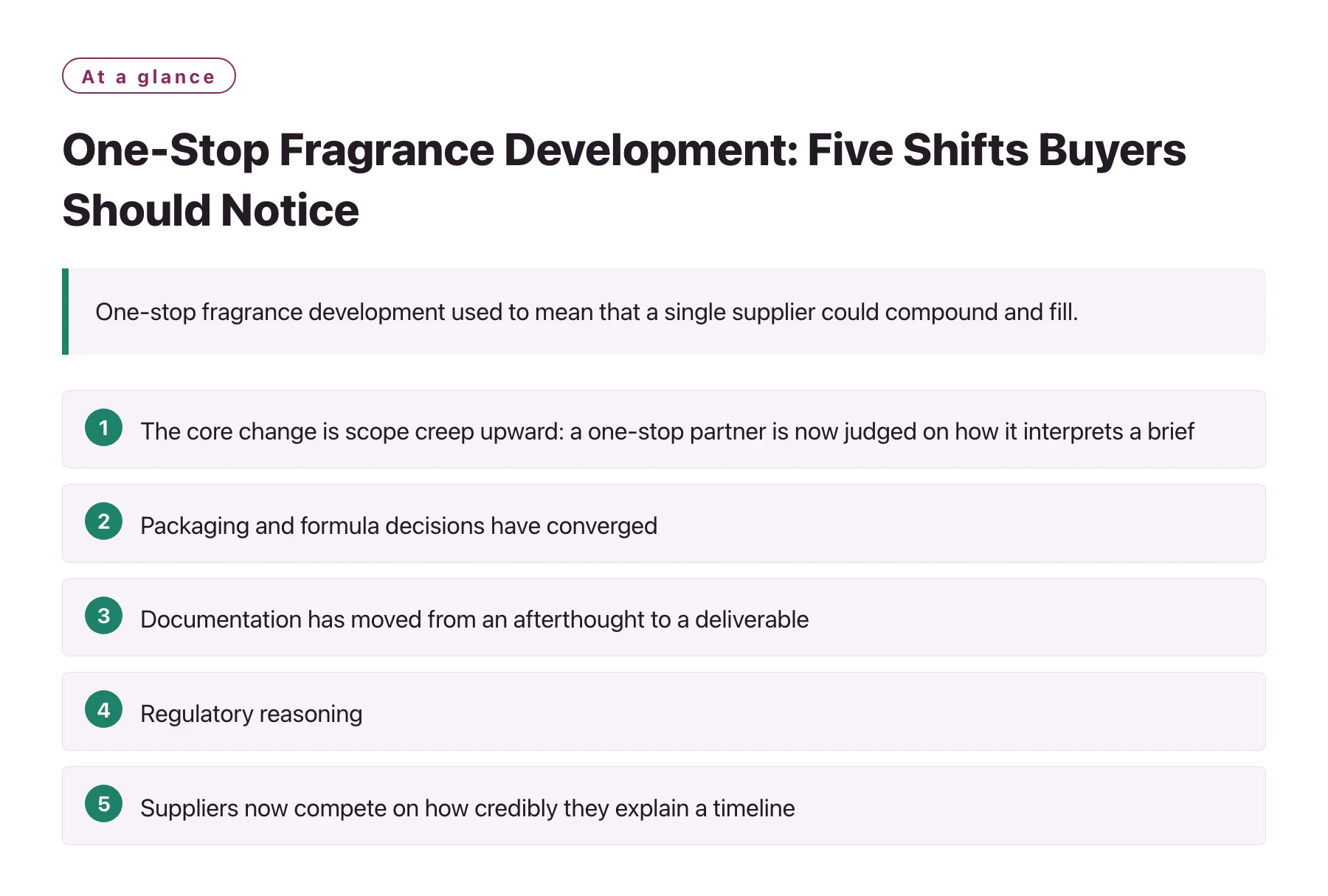
Key takeawaysThe core change is scope creep upward: a one-stop partner is now judged on how it interprets a brief, not only on how it executes a formula. · Packaging and formula decisions have converged, which means bottle, pump and closure choices now shape development rather than following it. · Documentation has moved from an afterthought to a deliverable, and buyers increasingly price development on the quality of the file they receive. · Regulatory reasoning, including how a formula aligns with fragrance safety standards and how labelling is supported, is expected as part of the service rather than bought separately. · Suppliers now compete on how credibly they explain a timeline, which has made program management a visible capability rather than an invisible one. · Because the shifts are uneven, the practical response is to ask which of them a specific factory actually provides instead of assuming the label implies all five.
Buyers who have sourced fragrance for a decade notice the change before they can articulate it. The quotations look similar and the conversations do not. A development meeting now starts with questions about the end product, the bottle and the market, where it once started with a scent direction and a volume.
This is written from the perspective of a sourcing director inside an established beauty brand who re-tendered a fragrance programme recently and found that the suppliers on the shortlist were offering what sounded like the same service but were describing five quite different businesses.
The five shifts below are not predictions. They are differences that already show up in how suppliers respond to a brief, and each one has a direct consequence for what a brand should ask before signing.
The five shifts, and what each one changes for a buyer
The first shift is interpretation. A one-stop partner is increasingly expected to take a commercial intention, a price architecture and a category context and turn them into a technical direction. That is a different skill from formulation, and it is why the quality of the first written response to a brief now predicts the project more reliably than the quality of the first sample.
The second shift is convergence between formula and packaging. Because a fragrance has to survive contact with a specific bottle, pump, liner and closure, packaging decisions have moved earlier in the process. A supplier that still treats the bottle as the brand's problem will discover compatibility issues late, and a factory that handles fragrance R&D and production properly now wants to see the packaging brief at the same time as the scent brief.
The third shift is documentation as a deliverable. Specifications with revision history, stability and compatibility reports, and retained reference standards have become part of what a buyer evaluates rather than administrative residue. This is partly driven by regulatory expectations and partly by buyers who have learned that an undocumented project becomes an unmanageable reorder.
The fourth shift is regulatory reasoning as a service. Brands increasingly expect a supplier to explain how a formula sits against fragrance safety standards for the categories it will carry, rather than simply declaring compliance. The materials and restrictions behind those standards are publicly documented, and the fragrance industry maintains a shared reference library for exactly this purpose [1].
The fifth shift is that timelines are now defended rather than announced. Suppliers are asked which stage is likely to consume the calendar, what the dependency is, and what happens if a component slips. That has turned program management from an internal function into something a buyer can evaluate in a meeting.
Why the change is uneven across suppliers
These five shifts have not arrived everywhere at once, and the reasons are structural. A manufacturer with a deep development bench will experience the first and fourth shifts naturally, because interpretation and regulatory reasoning are extensions of what its perfumers and regulatory staff already do. A manufacturer that grew as a production house may have excellent compounding and filling capability and very little of either.
Raw material supply is part of the picture. The large fragrance houses publish a great deal about how they approach ingredients, sustainability and creative direction, and that public material has raised buyer expectations of what a development conversation should sound like even at a much smaller scale [2]. Similar communication from other major ingredient suppliers has normalised the idea that scent development is discussed openly and technically rather than mysteriously [3].
Trade coverage of the wider industry reinforces the same expectation, with formulation and packaging increasingly discussed in the same breath, which is the second shift described above seen from the market side [4]. The consequence for a buyer is that the gap between the best and the average response to a brief is now much wider than the gap between their prices.
What to ask so the answers are comparable
The cleanest way to test which version of one-stop development a factory actually offers is to send the same written request to every candidate and compare the shape of the replies. Ask who interprets the brief and what they produce from it, when the packaging is reviewed relative to the formula, which documents arrive at handover, who signs the regulatory reasoning, and which stage the supplier expects to be the critical path. Five questions, five answers, and the differences are immediately visible.
It also helps to ask what the supplier will not do. A partner that can state its boundaries is describing a real process, while one that claims the whole chain without qualification is usually describing a marketing position. Where a programme mixes developed products with library-led ones, working with a manufacturer that supports OEM and ODM also removes an entire class of handover problem.
What this means for a brand that already has a supplier
An established beauty brand with a working relationship does not need to re-tender to benefit from these shifts. It needs to re-read the relationship. If the current partner already interprets briefs, already reviews packaging early and already hands over a complete file, the arrangement is more advanced than the contract probably says, and the sensible move is to write down what is being provided so it survives a change of account manager.
If the partner does not, the gap is usually visible in one specific place rather than everywhere. A factory that compounds and fills well but does not interpret briefs is not a bad partner; it is a partner being used for one part of a chain that now requires more coordination. In that case the brand should either add the missing capability internally or accept that coordination is its own job. What it should not do is assume that the label covers it. Where two product lines sit in one programme, the argument for consolidating R&D and manufacturing in one place becomes considerably stronger, and there is a practical account of what that consolidation covers and where the seams still are.
Sources
- IFRA Standards Library (International Fragrance Association) —— The IFRA Standards Library lists the restrictions the fragrance industry applies to individual fragrance ingredients, based on safety assessments; it is the reference point for compliant fragrance formulation.
- Givaudan —— One of the largest fragrance and flavour houses; public material on fragrance creation, ingredient portfolio and market segments.
- dsm-firmenich —— A global fragrance, flavour and nutrition company; public information on perfumery, ingredients and sustainability programmes.
- Cosmetics & Toiletries —— A technical magazine for cosmetic formulators, covering ingredients, formulation science and testing methods.
Frequently asked questions
What does one-stop fragrance development include today?
At its widest it includes brief interpretation, formula development, packaging and compatibility review, stability and safety documentation, regulatory reasoning and filling. The important point is that individual suppliers cover different subsets, so the scope has to be confirmed rather than assumed.
Why has packaging become part of fragrance development?
Because a fragrance has to perform in a specific container. Bottle material, pump, liner and closure can all affect what the consumer smells and how the product behaves over time, so packaging decisions made after the formula is fixed create avoidable rework.
Is documentation now a reason to choose one supplier over another?
It is a legitimate factor. A versioned specification, a retained reference standard and current test reports determine whether the second order is a purchase order or a new project, and suppliers differ substantially in how completely they provide them.
How can a buyer tell which version of one-stop service a factory offers?
By sending identical written questions to each candidate and comparing the replies: who interprets the brief, when packaging is reviewed, which documents arrive at handover, who signs the regulatory reasoning, and which stage is the critical path.
Do these shifts apply to smaller suppliers?
Some do and some do not, and that is exactly why the label is unreliable. A smaller specialist may interpret briefs extremely well and rely on the brand for packaging, while a larger production house may do the reverse.