Planning Notes for Qualifying medical supply manufacturers in China
Qualifying medical supply manufacturers in China starts with identifying the exact product, market, legal manufacturer, production sites, and outsourced steps. Buyers can then review quality-system evidence, product documents, process controls, traceability, and change management against defined requirements. A supplier’s certificate or database listing is one piece of evidence and should not be confused with product approval or lot acceptance.
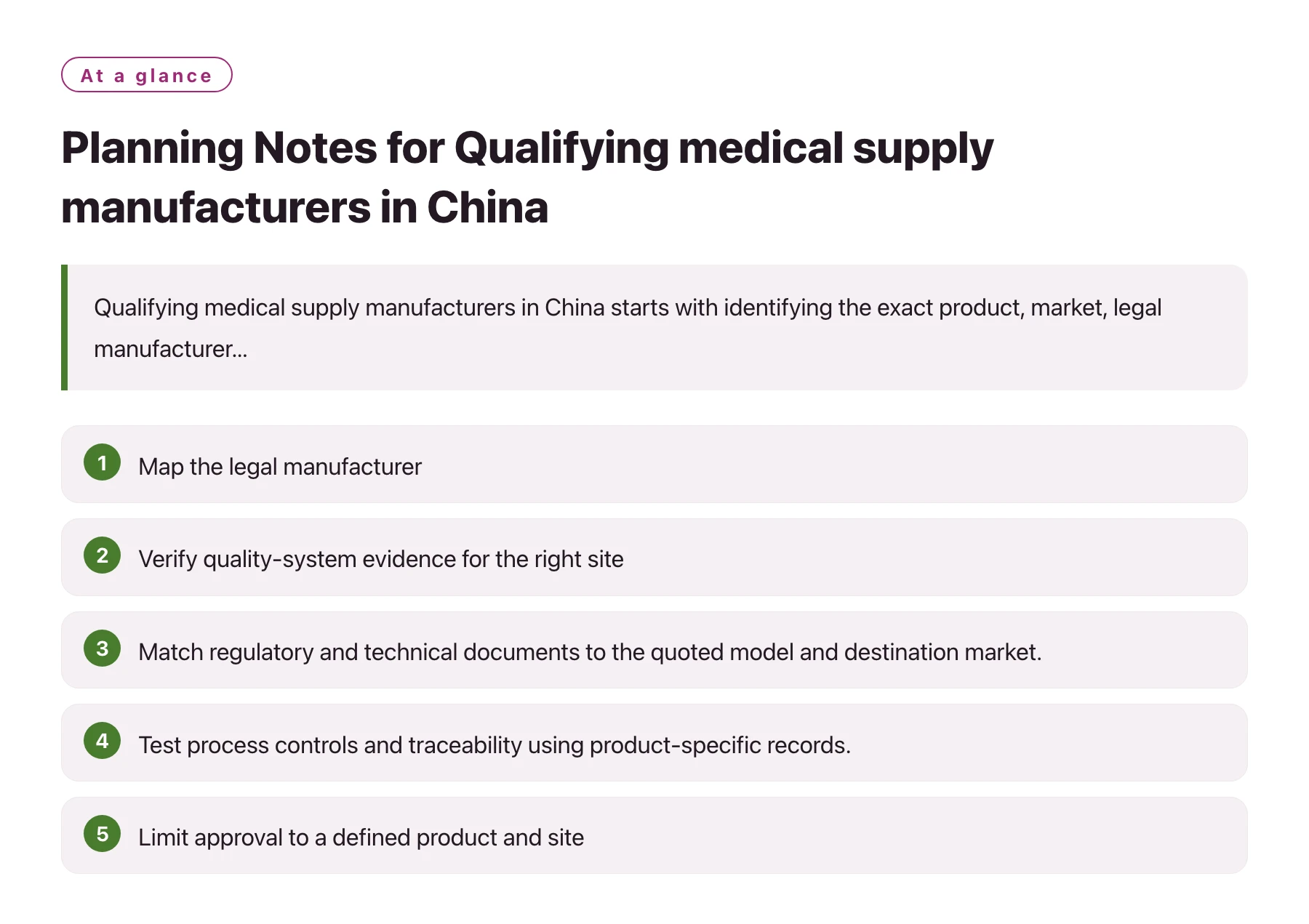
Key takeaways
- Map the legal manufacturer, actual production site, and subcontracted operations.
- Verify quality-system evidence for the right site, activity, scope, and dates.
- Match regulatory and technical documents to the quoted model and destination market.
- Test process controls and traceability using product-specific records.
- Limit approval to a defined product and site, then reassess meaningful changes.
Supplier qualification is a documented decision about capability for a particular product and scope. It should make clear what was checked, what remains open, and which approvals are still needed for an individual order.
Define which organization makes each part of the product
Begin with the product identity, intended use, destination market, and required configuration. Ask who designs, manufactures, assembles, sterilizes, labels, packages, and releases the product. A company described as a manufacturer may subcontract critical steps or sell goods made by another facility. Record the legal entities and physical sites so qualification covers the work that will actually occur.
Create a process map from incoming materials through finished goods. Identify suppliers of components and any outsourced testing or sterilization. Decide which processes are critical to product quality and what evidence is needed for each. For every site, confirm its role, contact, scope, and responsibility for records and change notices.
If the product category or manufacturing role is unclear, assign a qualified regulatory or quality reviewer to resolve it before purchase. Commercial terms such as medical grade or hospital use do not define a regulatory classification. Qualification should follow the exact product and market rather than the supplier’s marketing category.
Review quality-system evidence in context
Ask for the quality-system certificate and verify its issuer, scope, site, covered activities, issue and expiry dates, and any conditions. Confirm that the certificate covers the legal manufacturer and the operations relevant to the offered product. A certificate can support a supplier assessment but does not establish that a particular model, lot, label, or shipment satisfies every product requirement.
Review how the manufacturer controls documents, training, incoming materials, production records, inspection equipment, nonconforming product, corrective actions, and complaints. Request examples of procedures or anonymized records that show the process operates. Ask what information the supplier will provide if an audit or record review identifies a gap, and how corrective actions are verified before closure.
For devices intended for the U.S. market, FDA maintains a public Registration and Listing search that provides releasable establishment and device listing information and is updated weekly.[1] FDA states that registration or listing does not denote approval of the establishment or its products. Treat the database as a verification input, not a substitute for product-specific authorization or a quality assessment.
Match product and market documents to the quoted item
Build a document matrix that names each required certificate, declaration, test report, label, technical file, or import record; the responsible party; due date; product and site scope; and review owner. Ask the supplier to provide the exact product identifiers and current revisions. If the document uses a different model code or legal manufacturer, request an explanation and evidence that it covers the item being purchased.
Check whether the required document applies to the destination market and intended use. Requirements may depend on classification, claims, accessories, packaging, software, or whether the product is sold under a private label. Have a qualified reviewer confirm applicability; do not convert a supplier’s previous export experience into an assumption that every new SKU follows the same pathway.
For U.S. imports, identify who is the importer and which party supplies accurate manufacturer and device information for entry declarations. FDA explains that it checks relevant registration, listing, and other product requirements against submitted data; mismatches may prompt further review or detention. Use the current FDA guidance and the importer’s regulatory adviser for product-specific steps.
Assess process capability using product-specific evidence
Ask how critical characteristics are measured and controlled during routine production. The answer should identify process stages, acceptance limits, test methods, equipment, frequency, record retention, and the response to an out-of-limit result. For outsourced operations, ask who receives results and blocks product release when evidence is incomplete.
Use a sample or pilot lot to verify the proposed configuration and records. Identify whether the sample represents normal production, an engineering build, or a special demonstration. Review labels, packaging, traceability, and the relevant test evidence alongside the physical product. A sample can reveal a gap, but it does not establish long-term consistency by itself.
Agree how lot numbers connect raw materials, production dates, inspection results, packaging, and shipment cartons. Test the traceability path during qualification: ask the supplier to identify the source records for a selected finished unit and report how quickly the information can be retrieved. Record any limits and corrective action needed before approval.
Check change control and supplier continuity
List changes that require advance notice or approval: manufacturing site, subcontractor, raw material, formulation, tooling, sterilization provider, process parameters, inspection method, software, labeling, or packaging. Require an impact summary that identifies affected models and lots, the reason, supporting test or validation evidence, and the proposed effective date.
Ask how the supplier handles capacity constraints, component shortages, production interruptions, and facility changes. Identify alternate sources and whether substitution is permitted. A backup site or component may need separate qualification; define the review required before it can be used for a commercial lot.
Qualify communication paths as well as technical capability. Name a quality contact, regulatory contact, commercial contact, and escalation owner. Agree response times for serious nonconformances and the records the supplier must provide. Include a transition plan for returning tooling, samples, or controlled documents if the relationship ends.
Make the decision traceable and conditional where needed
Summarize evidence by requirement: met, open, or not applicable, with a citation to the document or record reviewed. State any conditions, limitations, and corrective actions. Use an approval status that the purchasing system can enforce, such as approved for a specific product and site, conditionally approved pending stated closure, or not approved for the intended scope.
Keep product qualification separate from order release. A supplier may be qualified while a specific lot still needs inspection, documentation, or regulatory review. The purchase order should reference the approved model, facility, specification revision, and required acceptance evidence. Reassess qualification when meaningful changes or performance problems occur.
For sourcing coordination with medical supply manufacturers in China, buyers may consider medical supply manufacturers in China as one starting point for supplier discussions. Confirm the current service scope and assign product classification, quality approval, and market authorization decisions to the buyer’s qualified owners.
Sources
Frequently asked questions
Does a quality certificate prove a medical product is approved?
No. A quality-system certificate has a defined organization and site scope. Product market authorization, classification, and lot acceptance are separate questions that require product-specific review.
What should be checked in an FDA registration or listing search?
Compare the manufacturer identity and listed product information with the supplier and quoted item, then have the regulatory owner confirm applicable requirements. FDA states that registration or listing is not an approval of the firm or its products.
Should the legal manufacturer and production site be the same company?
They may differ, but the relationship and responsibilities should be documented. Qualification should identify the actual site and subcontracted steps involved in producing and releasing the item.
When should a medical supplier be requalified?
Reassess when the manufacturer, site, subcontractor, materials, process, regulatory scope, or product performance changes materially, and according to the buyer’s risk-based supplier review process.