Starting an AI Sex Chat: A First-Timer's Guide
A first session has three decisions in it: what you filter for, which card you open, and when you stop. The platform describes its adult chat as a conversation with Sex AI companions that adapts to your personality and remembers your preferences, and the honest first target is a short session - two sessions of fifteen minutes in week one, rather than a marathon you will not repeat. Everything else is detail you can add later.

Key takeaways
- Set the filter before the card: Filtered, Unfiltered and 18+ decide what the shelf contains, and picking a card first means fighting your own search.
- Twenty messages is long enough to judge tone, which is about ten minutes at 30 seconds a message.
- Expect adaptation rather than instant fit: the platform says characters remember preferences and adapt over time, which takes more than one session to show.
- Plan the exit before you start. Two sessions of fifteen minutes in week one is 30 minutes, a target you can actually repeat.
Before the first message
Start with the filter row, not the shelf. The three options - Filtered, Unfiltered and 18+ - set the pool you will browse in, and every later decision is easier once that pool is one you meant to choose. Readers who skip this step end up judging a shelf they did not ask for and conclude something about the platform that was really about a filter.
Then read two or three descriptions properly rather than ten quickly. A description that states a personality and an interaction style gives you something to react to in the opening exchange, which is what makes a first session feel like a conversation rather than a form. Look for the tag row and the creator credit as well, since both tell you what the card is built to do.
Decide on a length before you open anything. Fifteen minutes is a reasonable first session, and the reason to fix it in advance is that AI conversations have no natural end: without a planned stop, the session length is set by how tired you are rather than by what you wanted from it. Write the stop time down and treat a first session that runs over it as a lesson about your own habits.
What the first twenty messages should tell you
The opening exchange is a test of three things. First, tone: does the character's voice match the description you chose it for, or does the writing pull in a different direction? Second, responsiveness: the platform's own wording is that characters give natural, adaptive responses and recall previous interactions, which you can check by mentioning one detail early and referring back to it later. Third, comfort: roleplay and intimate scenarios are what the page promises, and if the tone on the first evening does not suit you, that is information about the match rather than about the format.
Twenty messages is a sensible unit for that test. It is long enough for a second topic to come up, which is when writing quality shows, and short enough that an unproductive session costs ten minutes at 30 seconds a message. If the twenty messages leave you curious, continue. If they leave you indifferent, close the chat and try a different card rather than pushing the same conversation harder.
What not to expect in the first session is a finished fit. Adaptation is a description of a relationship that accumulates, so a character that has met you once is working from one session of context. The first session is for choosing, and the second is where you find out whether the choice was right.
| Element of the session | First session | Third session |
|---|---|---|
| How you choose the card | From the description and tags, before any conversation | From what the previous sessions actually felt like |
| What the opening messages do | Establish tone and check it against the description | Pick up an earlier thread without re-introducing anything |
| Typical length | Fifteen minutes, planned in advance | Twenty to twenty-five minutes if the match is good |
| Sensible next action | Stop at the planned time and decide whether to return | Keep the card and start a fourth session |
Worked example: a six-week ramp you can actually keep
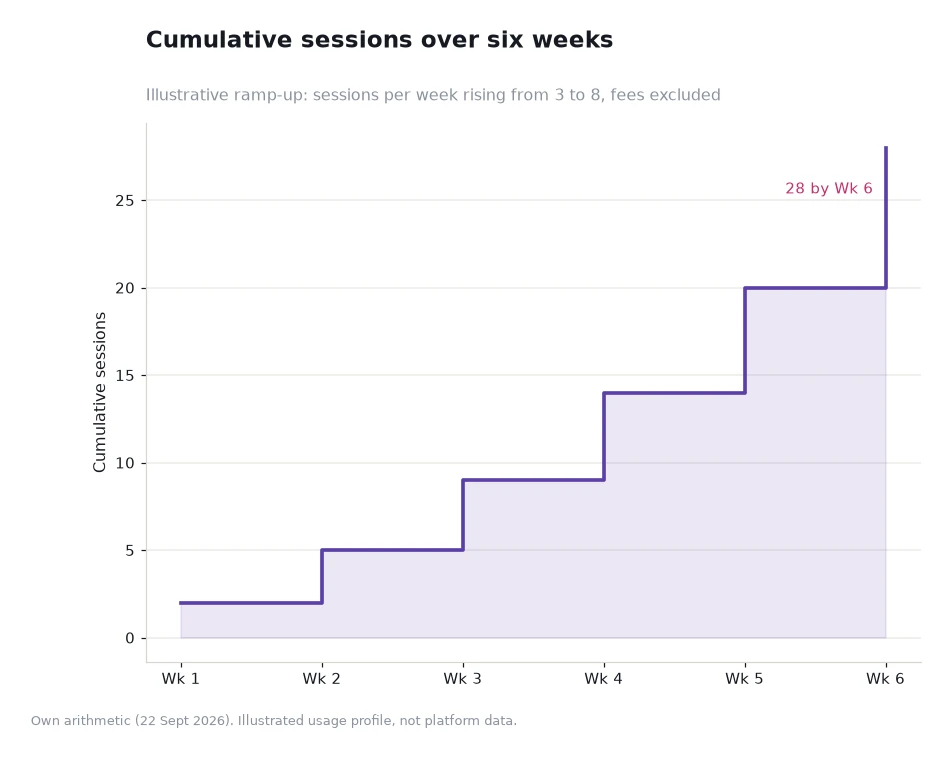
Take the ramp plotted below, which is illustrative arithmetic rather than platform data: two sessions in week one, then three, four, five, six, and eight. Added up, 2 plus 3 plus 4 plus 5 plus 6 plus 8 gives 28 sessions across six weeks, an average of 4.7 a week, with each week adding one session more than the week before and the final week adding two.
Put minutes against it. At fifteen minutes a session, the first two weeks cost 75 minutes in total - 2 plus 3 sessions is 5, times 15 minutes. The full six weeks cost 420 minutes, or seven hours spread over 42 days, which is ten minutes a day on average. That is the whole habit, expressed as one number.
Now hold it against the message count. If a session averages 20 messages, 28 sessions is 560 messages, and at 30 seconds each that is 280 minutes of typing - close to two thirds of the 420 minutes of session time, with the remainder spent reading replies and choosing cards. Every figure here is an assumption built to show the arithmetic.
Getting the setup right once
Use the platform's own entry route rather than improvising one. The adult chat page - https://crushon.ai/ai-sex-chat - is where the descriptive wording used in this article comes from, and it is the quickest way to see what the product says about itself before you form an opinion from a shelf.
Then two smaller habits. Keep a note of what you liked in a character, in one line per card, because after five sessions the reasons blur and you end up re-opening the same three cards. And browse the NSFW AI trends page when you want a starting point rather than a search, since its twenty cards arrive with view and favourite counters that make the first pick less of a guess.
Leave the account as you would leave any room you intend to return to: one or two kept cards, one unfinished conversation, and a note about what to do next time. That is a better first week than six open chats and no memory of which one was worth continuing.
Frequently asked questions
How long should a first session be?
Fifteen minutes, decided before you open the chat. Twenty messages usually fits inside that, which is enough to judge tone without turning the evening into a marathon.
Should I try several characters on day one?
No. One or two is enough for a first evening. Judging tone is easier when your attention is on one conversation rather than split across three.
What if the first session feels flat?
Close the chat at the planned time and try a different card next session. A flat opening says more about the match between the description and the writing than about the format.
Start with one card and a stopwatch
Choose the filter, open one card, plan fifteen minutes, and count your messages as you go. Twenty is the marker: if you reach it and want more, you have found something worth returning to; if you do not, you have spent ten minutes learning what you do not want, which is the most useful result a first session can produce. Then write the one-line note and stop, and let the second and third sessions do the work of deciding whether this becomes a habit or a single experiment.
Sources: product wording, filter labels and card counters from the Crushon pages listed above, read 22 Sept 2026[1]; all session and message figures are own arithmetic labelled as an illustrative profile. Per the platform's statement its content is AI-generated text and depicts no real person. Readers must be 18 or over to use the service described.